What Pages Does a Small Business Website Need?
What Pages Does a Small Business Website Need?
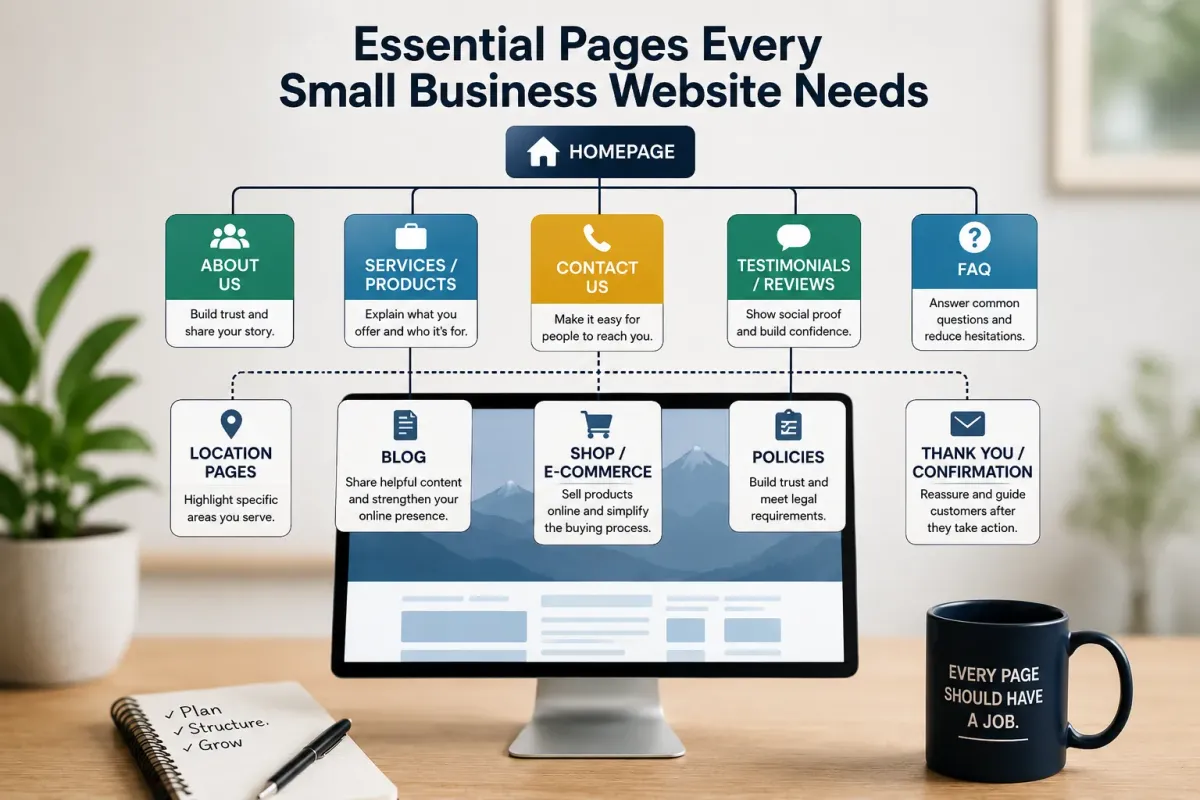
Most small business websites either have too many pages or not enough of the right ones. The question is not how many pages you can add. It is which pages actually do work for your business.
The right answer depends on what your business sells, how customers find you, and what the website needs to accomplish. That said, there is a core set of pages that almost every small business website needs, a few that many businesses overlook, and several that get added for the wrong reasons.
Here is a practical breakdown of what belongs on a professional small business website and what each page needs to do to earn its place.
The Essential Pages Every Small Business Website Should Have
Home Page
Your home page is not a welcome mat. It is your clearest, fastest answer to one question: "Is this business right for me?"
A strong home page communicates what you do, who you serve, where you are located if location matters, and what the next step is. Many visitors will make their stay-or-leave decision well before reaching the bottom of the page, so the top of your home page carries significant weight.
A home page that tries to explain everything usually explains nothing. Focus on clarity over completeness. Your other pages handle the depth.
Services or Products Page
This is frequently the most visited page on a service-based business website, and it is often the most neglected. A list of service names with no explanation is not a services page. It is a menu with no descriptions.
A useful services page tells the visitor what you offer, who it is for, what problem it solves, and what they can expect from working with you. If you offer multiple distinct services, consider giving each one its own page. Individual service pages give each offering room to be explained properly.
There is also a practical clarity benefit for search engines and AI-powered discovery systems. A clearly written, specific service page helps those systems understand what the business does, who it serves, what problem it solves, and where it operates when location is relevant. That kind of structured, accurate information is easier for both humans and machines to process than a vague paragraph that gestures at a dozen things at once.
About Page
People do business with people they trust. Your About page is where that trust starts to form.
A strong About page does not just list credentials or recite your founding story in chronological order. It connects your background to why it matters to the customer. Why did you start this business? What do you know or do that others don't? Why does that matter to the person reading right now?
For founder-led businesses in particular, the About page can be one of the most powerful pages on the site. Do not treat it as an afterthought.
Contact Page
The goal of a Contact page is straightforward: give a qualified visitor a clear, low-friction path to take the next step. A visitor who is ready to act should never have to figure out how to reach you.
What that looks like in practice depends on how your business actually handles leads and customers. Depending on your business model, the right contact options might include a phone number, an email address, a contact form, an online booking link, a live chat tool, an AI-powered assistant, a text messaging option, or some combination of these.
There is no single correct format. The format that matters is the one that matches how your customers prefer to communicate and how your business is actually set up to respond. Putting a contact form on your site because "every website has one" is not a strategy. Putting the right conversion path in front of a ready buyer is.
Whatever you choose, make sure it is reachable from every page of your site through your main navigation or footer. Never make a motivated visitor hunt for the option.
Pages That Most Service Businesses Should Consider Adding
Individual Service Pages
If you listed multiple services on a single page, consider breaking them out. A roofing company that offers residential repairs, commercial roofing, and storm damage inspection serves three different customers with three different needs and questions. One page cannot speak to all three effectively.
Individual service pages also help with local search visibility. A page dedicated to a specific service in a specific area gives search engines something concrete to index and match to relevant queries. The same principle applies to AI-powered search experiences, which are increasingly trying to match a user's specific question to a specific business capability. The more clearly your pages define what you do and where, the easier that match becomes.
Testimonials or Reviews Page
Social proof is one of the most reliable ways to move a hesitant visitor toward taking action. A dedicated page for testimonials, reviews, or case study highlights gives potential customers confidence that others have made the same decision and it worked out.
If you have strong Google reviews, linking to your Google Business Profile from this page adds credibility because those reviews exist outside your own site and cannot be curated.
FAQ Page
A good FAQ page does two things at once. It answers the real questions your prospective customers ask before deciding to contact you, and it gives search engines clearer signal about what your business covers.
That same clarity can benefit AI-powered search systems. When a potential customer asks an AI assistant a question about your type of service, a well-written FAQ that directly addresses common questions makes it easier for those systems to surface relevant information about your business. The key is that the questions have to be real ones. FAQs built around the actual objections, hesitations, and questions you hear in consultations and sales calls are genuinely useful. FAQs stuffed with generic questions nobody actually asks are not.
Location Page (for local businesses)
If you serve a specific city or region, a dedicated location page can strengthen your visibility in local search. This is not a page that simply says "we serve Anchorage." It is a page that explains what you offer in that market, provides relevant local context where it genuinely fits, and makes clear who the page is for.
Businesses serving multiple cities sometimes create individual pages for each major service area. Done well, this works. Thin location pages that simply swap a city name into a template provide little unique value and are unlikely to serve users well.
Pages That E-Commerce and Product Businesses Need
If you sell physical or digital products, the page structure shifts considerably. In addition to the core pages above, a product-based business typically needs:
- Shop or product catalog page. The entry point to your inventory, organized clearly by category or collection.
- Individual product pages. Each product needs its own page with strong descriptions, specifications, photography, pricing, and a clear path to purchase.
- Cart and checkout flow. These pages need to be fast, simple, and friction-free. Every unnecessary step between intent and purchase costs you sales.
- Shipping and returns policy page. Customers want to know what happens if something goes wrong before they buy. A clear, easy-to-find policy page reduces hesitation and disputes.
For businesses whose primary website goal is selling products, the platform choice matters as much as the page structure. A purpose-built e-commerce platform handles the cart, checkout, payment workflows, and catalog architecture in ways that a standard informational site setup is not designed to support.
Pages You Probably Do Not Need Right Now
More pages is not always better. Adding pages that serve no clear purpose dilutes your site's focus and creates maintenance overhead with no corresponding benefit. Every page should have a job. If you cannot clearly state what a page does for the visitor, it probably should not exist yet.
A blog or resource section is worth thinking carefully about before adding. Consistent, genuinely useful content can build authority and answer real customer questions over time. But a blog is worth building only when it is part of a real content strategy aimed at actual business goals. Publishing generic posts simply because someone said you "need a blog for SEO" usually accomplishes very little. A focused library of strong evergreen content that answers real customer questions is more valuable than a high volume of posts that exist mainly to fill space. Treat content as a long-term business asset rather than a box to check.
Team pages, gallery pages, and resource libraries all have legitimate uses in the right context. Before adding any of them, ask: what does this do for the visitor, and does it move them closer to contacting us or buying from us?
How Many Pages Does a Small Business Website Actually Need?
There is no universal right answer. A local service business with one core offering and a well-defined service area might operate well with five focused, thoughtfully built pages. A multi-service company with several locations, a content strategy, and e-commerce functionality might need thirty or more.
Page count follows the business, not the other way around. The variables that actually drive it include:
- Number of distinct services or products
- Number of locations or service areas
- How the sales process works and where the website fits into it
- Customer questions that need answering before someone buys
- E-commerce requirements
- Functionality and integration needs
- Search and content strategy
Use the ranges below as practical starting points only, not targets. The goal is not to hit a number. The goal is to have every page doing something useful.
| Business Type | Typical Starting Range | Core Pages |
|---|---|---|
| Solo provider or freelancer | 1–3 pages | Home, Services, Contact |
| Local service business (single location) | 4–7 pages | Home, Services, About, Contact, FAQ or Testimonials |
| Multi-service business | 8–15 pages | Above plus individual service pages |
| Multi-location business | 12–25+ pages | Above plus location pages |
| E-commerce or product business | Varies significantly by catalog | Shop, product pages, cart, policies, plus core pages |
What Mandeaux Digital Builds Around
When we build a website for a client, we do not start by assigning them to a package and working backward. We start by understanding the business. What does it sell? Who buys it? What questions do those buyers have? What does the website need to accomplish in this specific business context?
From there, the right page structure and the right approach become clear. The technology should follow the business need, not the other way around. A business that needs a focused, professional web presence to establish credibility and give customers an easy way to reach them is a very different project from one that needs a multi-service architecture, deep SEO structure, lead generation infrastructure, or a full e-commerce store.
For businesses that need a clean, professional site without the scope of a larger custom project, Website Lite is built for that. It is a professionally designed and built website, not a template subscription or a DIY builder. Clients do not receive a traditional website backend login for making their own changes. Instead, changes are requested through Mandeaux Digital via normal communication channels. Website Lite is available in two configurations:
- One-Page Website Lite: $497 one-time build fee, plus $45 per month for hosting and ongoing care
- Up-to-Five-Page Website Lite: $997 one-time build fee, plus $45 per month for hosting and ongoing care
The $45 monthly plan includes hosting, backups, security, mobile optimization, on-site SEO, analytics installation, and two free website update requests per month. You can learn more or get started at sites.mandeauxdigital.com, or go directly to checkout at checkout.mandeauxdigital.com/website-lite.
For businesses that need more, custom projects may involve custom development, WordPress, Shopify, or another approach depending on what the business actually requires. These projects may include advanced integrations, e-commerce, automation, sophisticated SEO architecture, custom functionality, or specialized customer experiences. Scope is determined by the business requirements, not a fixed package. If you are not sure which path fits your situation, Let's Talk Business is the right place to start.
Frequently Asked Questions
How many pages should a small business website have?
It depends on the business. Most local service businesses do well starting with five to seven focused, well-built pages. What matters more than the count is whether each page has a clear purpose and serves the visitor's actual needs. Page count should follow the business, not precede it.
Do I need a blog on my small business website?
Only if you are committed to building a real content strategy around it. A blog is valuable when it answers genuine customer questions and supports a long-term content plan. Publishing posts without a clear purpose or audience rarely produces meaningful results. If you are not ready to invest in consistent, useful content, focus on making your core pages exceptional first.
Should every service have its own page?
Generally yes, especially when your services are distinct enough that a customer searching for one would not necessarily be searching for the others. Individual service pages help search engines understand your specific offerings and give each service the space to be explained properly. They also help AI-powered search systems match specific customer questions to the right service.
Does my small business website need a privacy policy page?
If your website collects any personal information, including through contact forms, email capture, or analytics tools, a privacy policy is important and may be legally required depending on your location and applicable laws. Consult a legal professional for guidance specific to your situation.
What is the most important page on a small business website?
It depends on the business, but for most local service businesses, the home page and the services page carry the most weight. Visitors typically land on one or the other first and decide quickly whether to keep reading. Both need to be clear, specific, and immediately relevant to the visitor's situation.
Does my website structure affect how AI search tools find my business?
Clear website architecture, accurate service pages, and well-written FAQ content can make it easier for both traditional search engines and AI-powered systems to understand what your business does and who it serves. This is not a guarantee of any specific ranking or citation outcome, but building a website that communicates clearly is consistently good practice for human visitors and machine systems alike.
The right starting point for any website decision is understanding what the site needs to accomplish. If you are not sure which page structure fits your business, that conversation is worth having before a single page gets designed. Visit sites.mandeauxdigital.com to explore Website Lite, or book a no-cost business conversation at book.mandeauxdigital.com if your situation calls for a more custom approach.

